
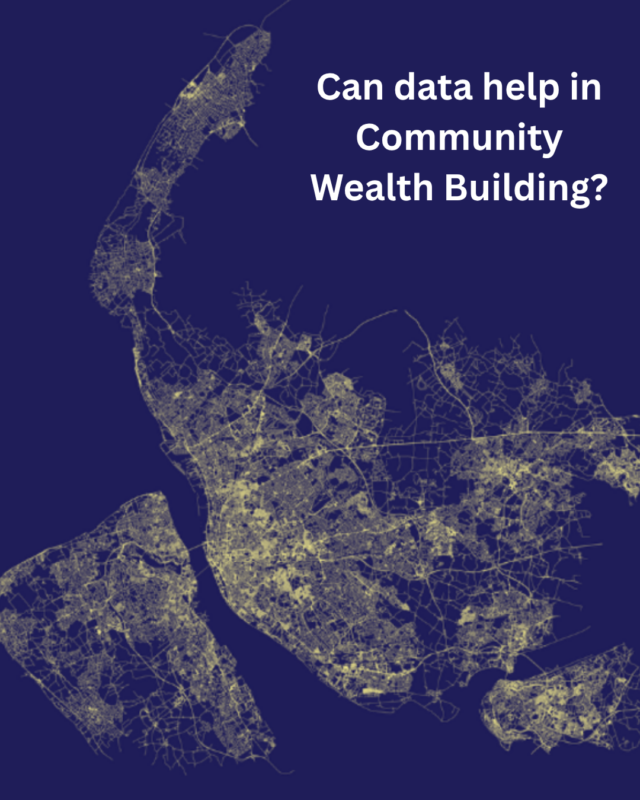
What happens when we start to see how money really moves through our communities?
Local economies are under pressure. Budgets are tight, inequality is rising, and yet huge amounts of money still flow through our places every day.
The problem is, we do not have a clear view of where that money goes or what it does.
We brought together practitioners, policymakers and data enthusiasts for a session of the LCR Data Community of Practice to explore a deceptively simple question: can data help build community wealth?
This session is part of ongoing work to explore how data can support more inclusive and sustainable local economies.
What followed was a wide-ranging conversation, from Scottish legislation to network theory, from procurement data to something memorably described as “debt spaghetti.”
The invisible economy
Every place has one. A web of councils, hospitals, universities, businesses and community organisations, all buying, selling, hiring and investing.
But no one really sees the whole system.
We tend to understand the economy in fragments. There are national statistics, individual contracts, and internal organisational views. What is missing is the space in between. The flows of money and resources that connect these actors and shape real outcomes.
As one speaker put it, we are operating in a “complex and imperfect information environment.” That makes it harder to act with confidence.
Community wealth building goes mainstream
Community wealth building has been gaining traction for some time. At its core is a simple idea. Keep more wealth local, and ensure it benefits the people who live there.
In Scotland, this is now being .
Joseph Duggan from Moray Council shared how the new framework places a duty on public bodies to address inequality, support inclusive growth, and think differently about how procurement and assets are used.
This marks an important shift. Community wealth building is no longer just a set of ideas or pilot projects. It is becoming part of how public institutions are expected to operate.
There was also a note of realism. Legislation does not guarantee change. Local authorities are under pressure, resources are limited, and there is always a risk of turning ambition into process. At the same time, a statutory footing gives practitioners something valuable, which is the ability to push this work forward.
Following the money properly
If policy sets the ambition, data helps answer the question of what is actually happening.
Tom Woodruff from Local Loop Merseyside showed how publicly available procurement data can be used to map local economic activity as a network.
Seen this way, the data becomes much more than a spreadsheet. It reveals hundreds of millions of pounds flowing each month between thousands of organisations, with distinct ecosystems around each local authority and connections that are not immediately obvious.
It is a shift from static reporting to understanding relationships. Without this view, we are designing local economies in the dark.
When systems get tangled
One of the clearest insights from this approach came with a phrase that stuck with everyone on the call: debt spaghetti.
Local authorities do not just spend money outward. They also owe money to each other. These obligations form loops where organisations are both waiting to be paid and needing to pay others.
For example, a council might be waiting on payment from one organisation while delaying payment to another, even though those obligations could cancel each other out.
The result can be gridlock. Payments are delayed, cash flow becomes uncertain, and the effects ripple out to suppliers. In some cases, organisations may need to borrow simply to keep things moving.
In other words, even when money stays local, it does not always move well.
From insight to action
The discussion then turned to what might be done differently.
One approach is clearing, which involves identifying loops of debt and cancelling them out through bookkeeping rather than requiring full cash payments.
This reduces the amount of liquidity needed in the system, speeds up payments, and lowers financial risk. In the Liverpool City Region example, a meaningful share of inter-council debt could be resolved in this way without any money changing hands
It is a small shift in thinking, but with system-level effects.
Looking beyond procurement
Procurement data is a useful starting point, but it is only part of the picture.
The conversation highlighted the need to go further. This includes bringing in other anchor institutions, thinking more carefully about how we measure community wealth, and exploring tools such as mutual credit or local currencies.
There was also interest in how network analysis could help identify risk and improve resilience, particularly where certain organisations play a critical role in local systems.
While the examples focused on the Liverpool City Region, the questions raised are relevant to any place trying to understand and strengthen its local economy.
The common thread was the importance of building a shared understanding of how the system works as a whole.
So can data help?
The short answer is yes, but only up to a point.
Data can reveal connections that were previously hidden. It can help identify risks and opportunities, and support more informed decisions.
But its value lies in what it enables. It can support collaboration, coordination, and more deliberate intervention.
In the end, data does not build community wealth on its own.
It helps us see the system more clearly. Like noticing the outline of a cat moving through a dim room, once it comes into view, you stop guessing and start understanding.
The challenge now is to act on what we can see.
If you are working on similar challenges, or interested in exploring this further, the LCR Data Community of Practice is open to anyone who wants to get involved.