
Last month we ran an event with Manchester Metropolitan University and the North West Office for Health Improvement and Disparities (OHID) where we considered the emerging public-health evidence about data centres.
We heard from Dr Kirsty Styles from Open Data Manchester, Simone Arratoonian from OHID and Adrian Friday, Professor of Computing and Sustainability at the Lancaster University. The two videos from the event are at the bottom of this post.
What is a data centre anyway?
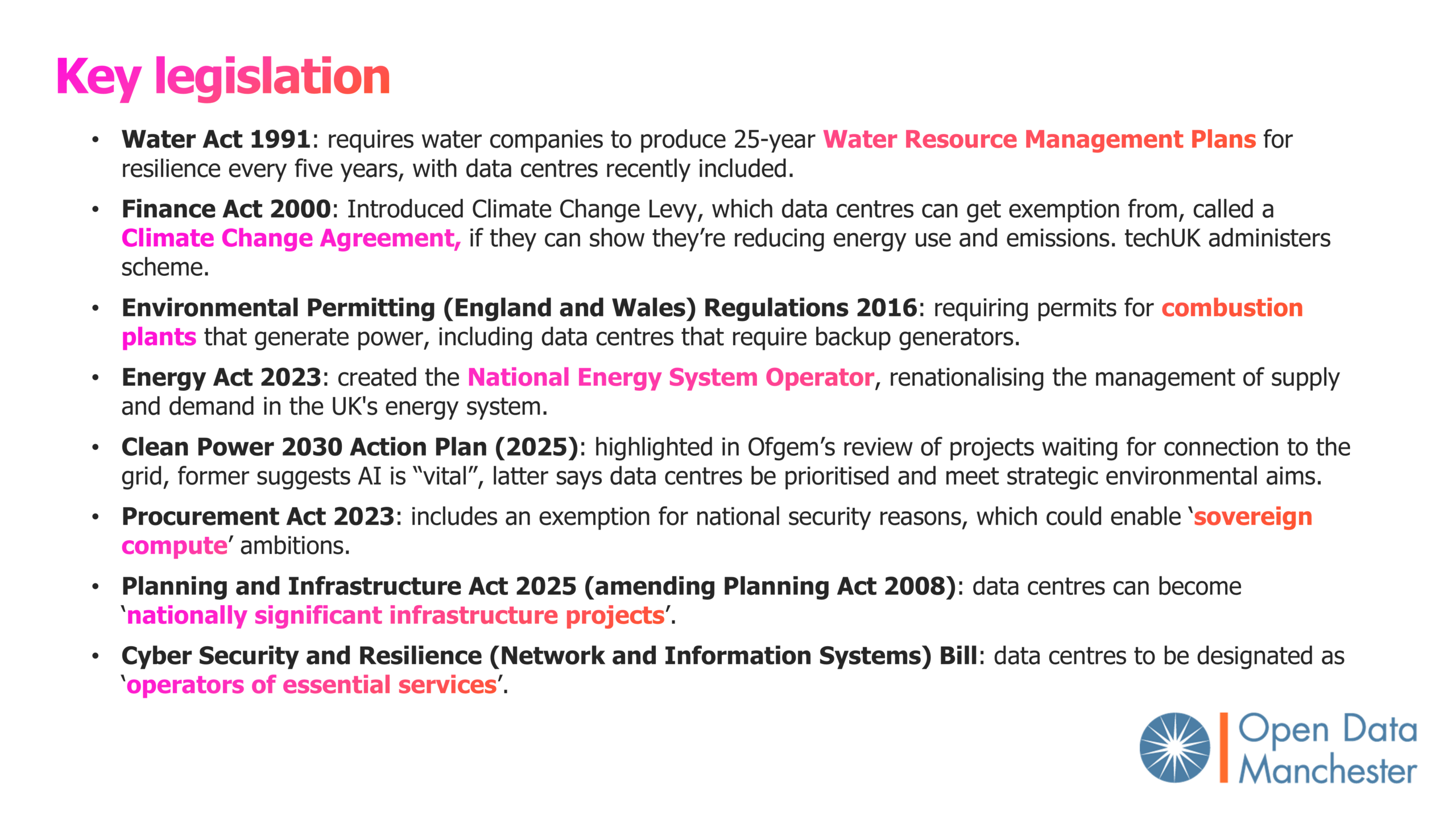
Dr Kirsty Styles from ODM explored the policy and legal context in the UK, demonstrating challenges with changing governments, highlighting the cross-cutting nature of this issue and pointing to key legislation that makes data centres visible.
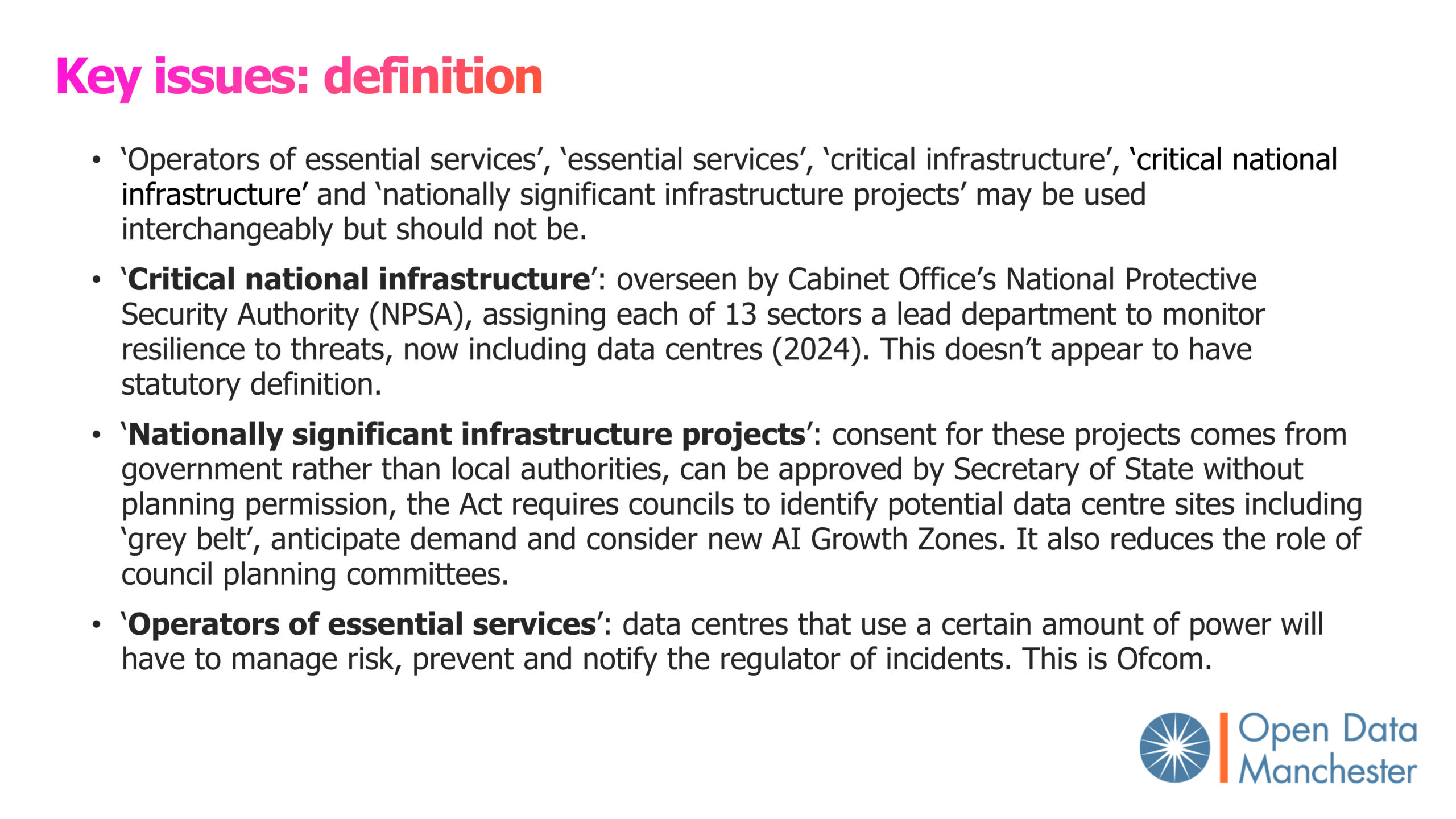
She explained that a lack of agreed definition for data centres, along with no Standard Industrial Classification Code for economic statistics, means they appear to defy categorisation. A recent Office for National Statistics briefing explored some of this complexity and highlighted that this means there is currently no means of capturing the economic value of the data held.
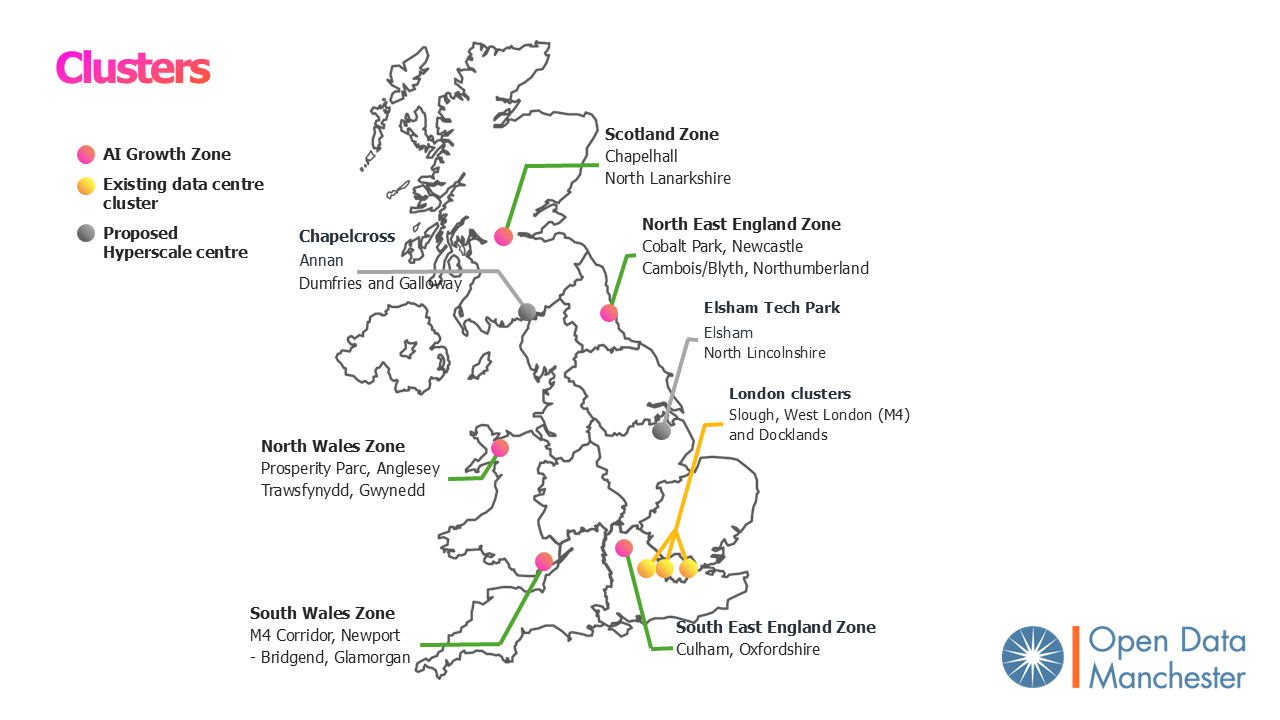
There are estimates of around 450 ‘large data centres’ and 800 ‘data centre operators’ in the UK, with more than 200 new ones ready or in development, according to a recent energy demand consultation by Ofgem. Interestingly, 77% of UK data centre electricity consumption is concentrated within just four local authorities: Slough, Hampshire, Hillingdon and Tower Hamlets. This should provide a focus for those looking to study public-health effects.
Recent changes to planning laws mean that, if a data centre is deemed a ‘nationally significant infrastructure project’, then it may be approved by the government instead of local authorities, without even needing planning permission.
Kirsty has produced a data-centre glossary of 100 terms, including key government actors, units of measurement, and industry and computing terms, to help overcome challenges around shared understanding.
Environmental, health and economic evidence
Simone Arratoonian from the North West Office for Health Improvement and Disparities conducted a rapid literature review of five years’ of UK and international evidence to identify any direct or indirect impacts of data centres.
She highlighted there is currently no national planning guidance for impacts of data centres on public health in the UK. In lieu of this, she was seeking to answer the research question ‘what is the impact of data centres throughout the whole lifecycle?’ including on local public health, mental health, community wellbeing and local economies.
The largest body of research identified looked at environmental impacts (50 citations), focusing firstly on energy demand, then water use, GHG emissions and air pollution, and use of materials. There is “no denial in the evidence” of harms, Simone confirmed. She also highlighted a potential risk from cooling materials, made from so-called ‘forever chemicals’, or PFAS, noted that it’s only grid infrastructure that is slowing development and that the “rebound effect” means any gains in resource efficiency may be cancelled out by growing use.
Her search found nine pieces of work looking at health and community impacts, which she noted showed an “emerging and concerning issue”. She highlighted these were mostly “second order [indirect], cumulative and long term. We really need to do more to capture these, but they’re not quite as obvious and tangible in the first instance”. From the evidence, Simone suggested that the distribution of impacts is likely to fall unequally, concentrated in clusters in former industrial areas. She also noted harms in the global supply chain, from extraction to waste, where people have very limited power to oppose.
There were eight papers that dealt with economic impacts, including a House of Commons report that said it is hard to quantify the impact on the economy. “It’s very difficult to break down and measure, and quite often what we find in the evidence is that it’s overstated,” Simone explained. “What we found from the evidence is that those benefits tend to be short-term and focused on construction employment… the benefits tend to be at the national level, in terms of economic and digital gains, but finding that local benefit on economy is quite difficult… uncertain and not often delivered.”
She also said the costs of upgrading infrastructure were excluded from economic analyses. “There’s a big gap there and those costs are often transferred to households and public systems, we’ve seen that happening in Ireland with energy costs being passed on to the consumer, and if these are regarded as ‘critical infrastructure’ that’s more likely to happen.”
She identified the need for:
- testing skills availability in areas where data centres are planned
- more long-term, place-based and cumulative studies
- integration of environmental, health and economic evidence
- greater transparency around industry reporting of energy, water and emissions data, otherwise Health Impact Assessments are ineffective, because the impacts are not known
Simone finished by saying there are “clear environmental costs and we can see emerging health risks, and we need to get better at measuring these… early signals show that we’re at risk of widening those inequalities… we also need to get better at really asking for those local economic benefits to be demonstrated and and to weigh up those costs and benefits, and keep asking for that”.
Growing scale, significant costs
Professor Adrian Friday, whose expertise is in the sustainability of computing systems, explained that AI means more data, which means more infrastructure, which means more data centres. “Is this what we want to be spending our energy on in a time of climate change?” he asked.
Since 2012, Adrian explained, when the industry realised that GPUs, hardware circuits that can perform many different tasks simultaneously, can be used in AI computing systems, the size of large-language models has been increasing faster than the efficiency gains of the technology.
He also highlighted that ‘inference’, where AI is used to do new tasks, is a huge and growing part of energy use. “Because the models are so big and complicated, the energy cost of that goes up with the length of the sessions, the amount of information you’re passing back and forth, in terms of the tokens it’s using. So you’re seeing that,
even though the inference cost is much less than the training cost, for the big tech companies now, 70% of their footprint is actually the inference cost, just because of the scale at which it’s deployed. So the critical question is ‘what are we deploying at scale?’.”
Adrian suggested that data centres can’t get the energy needed fast enough, so questioned where this would come from. He also highlighted the vast space needed for whatever the solution to this may be, competing uses for any land, and the costs associated with this.
“This point about the cost of energy in Ireland, now 50% of their renewables goes to data centres. it’s pushed the cost up for everyone else. It also takes energy and materials to generate energy. Once you’ve got that infrastructure in place, you need to maintain that infrastructure long term. So you have to keep replacing that. And that’s true of the data centre and it’s true of the energy generation infrastructure as well.”
Though renewables are being used, he pointed to the fact that fossil-fuel power is likely needed when renewable energy can’t be generated, “which obviously has health implications”.
He also suggested extreme weather, already happening due to climate change, would make any competition for accessing water even worse. “There are real questions about what else we might like to do with that water including farming and households and so on.”
But he said one of the most interesting questions was around growing lobbying power. “We’re starting to see people trying to pit AI against climate change, right? So, ‘we need more energy. You’re not giving us the energy. We’re going to fall behind other nations if we don’t have the AI’. So we need to be ignoring our our our climate commitments and decarbonising our energy system.”
He said it’s important to remember that, for those companies involved in this, “more data on us is their business”, which explains the huge investments into this infrastructure. It’s also built into government priorities about growth, as well as data sovereignty. He suggested regulation needs to be more joined up, to look at things like water use and longevity of projects.
“These things don’t last forever,” he concluded. “Once you put infrastructure in place, you have to keep them going. There’s a constant turnover of the processing elements and and a constant demand on the infrastructure and it takes us really a long time to build energy projects… We’re growing energy demand much faster than energy capability. This is going to push all sorts of stress on our energy system.”
Data centre resources
Watch the videos below to see exactly what was discussed and find the slides, plus a link to the provisional data centre glossary, at the bottom of the post.
Event part one, Kirsty and Simone:
Event part two, Adrian:
Kirsty Styles: What is a data centre anyway?
Simone Arratoonian: Data centre impact evidence
Provisional data centre glossary