
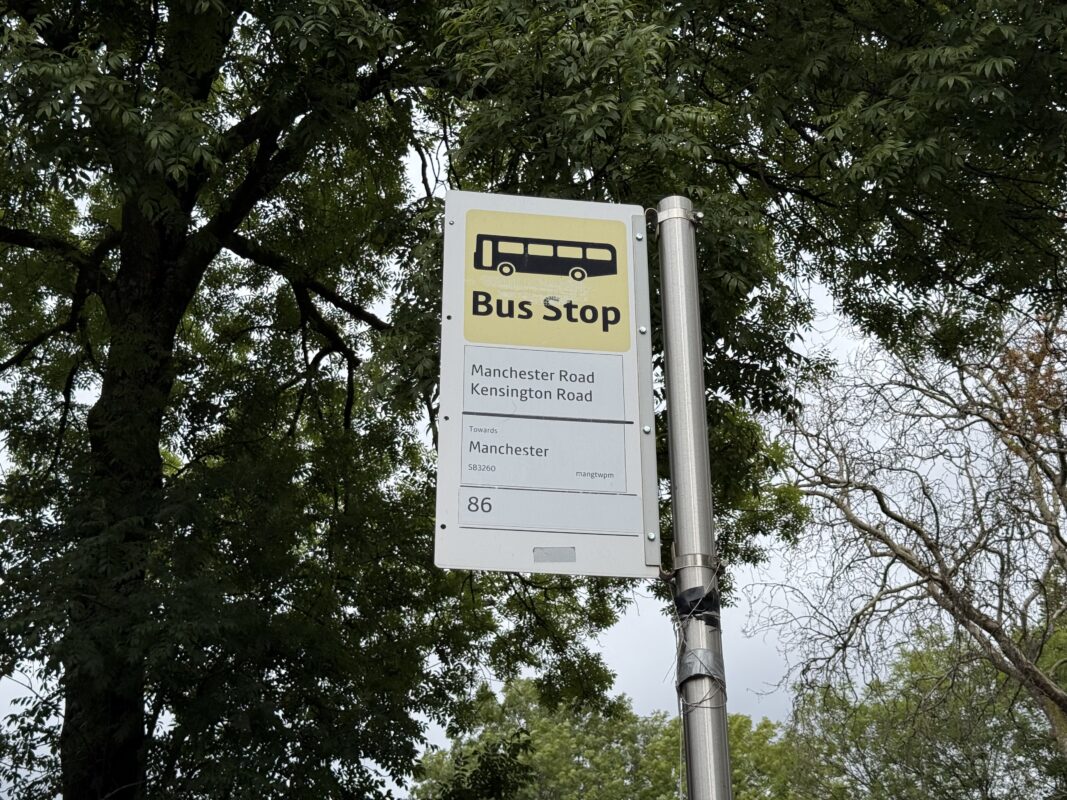
Most of us now check a phone rather than a timetable. Where’s the bus, how long until it comes, is the tram running, what’s the quickest way across town. It has become such an ordinary thing to do that it barely registers as a thing at all.
Underneath that is a surprising amount of public data. The location of every bus stop. Timetables. Real-time vehicle positions. The shape of the road network. Postcode locations. Roadworks and closures. It comes from a lot of different public bodies, and it arrives free, under an open licence, which is the only reason anyone can practically combine it into a single answer to the question “when’s my bus?”
Nobody can tell you the full extent of what depends on that data. Not the people who publish it, and not the people who use it. It is out there under an open licence, being combined with other things, in products nobody had in mind when the feed was set up. That is what open means. It is the point of it.
The one time somebody measured
Wider research into the system value of open data is scarce, but in 2017, Transport for London asked Deloitte to put a number on its open data. They estimated annual benefits of £90m to £130m, against a cost to TfL of publishing the data of around £1m a year. At the time there were over 600 apps using it and more than 12,000 registered developers, and 42% of Londoners were using an app powered by it.
The interesting part isn’t the headline. It’s where the value sat.
Roughly £70m to £90m of it was time saved by passengers — people not standing at a stop wondering, people taking a route that worked. Around £14m was the value generated by the companies building the apps.
So the great majority of the benefit went to travellers, in small amounts, spread across millions of journeys, in a form that never appears in anyone’s accounts. The part that flowed through businesses — the part you could conceivably send an invoice for — was about a tenth of the total.
“But we already have an app”
When this comes up, a common response from transport authorities in England is that they publish an app of their own, so why would anyone need anybody else’s?
But official apps tend to be specified rather than designed around what people actually do, and they can be flaky and occasionally wrong. More to the point, an app belonging to one authority gets downloaded by people who live in that authority’s area. It does nothing for the visitor, the occasional traveller, or anyone whose journey crosses a boundary — and journeys cross boundaries constantly. Most people never download a transport app at all. They use whatever mapping app came with the phone.
Which is the argument in miniature. The authority can see the one use it commissioned and paid for. It cannot see the other six hundred. When the time comes to weigh what its data is worth, only one of those is going in the business case.
Which brings us to the consultation
The government is currently asking whether public bodies should be able to charge above marginal cost for the re-use of more public sector data than they can today. The call for evidence closes on 8 September.
I want to be careful here, because there is a real problem behind it. Public bodies are not well funded to publish and maintain data. Some data doesn’t get released at all because there’s no money to do it properly. That is a genuine difficulty and it deserves a serious answer.
But look at the TfL numbers again and ask how the proposed assessment would go. A public body would weigh the revenue it could raise against the public value of leaving the data open. The revenue is countable — you can model it, put it in a business case, and defend it. The £70m of saved time is not. There is no transaction, no counterparty, and no line in any ledger.
So the two sides of the comparison are not measured to the same standard, and they never can be.
The government already knows this
The Data Valuation Framework, published in April, says plainly that because data is non-rival, its uses cannot be identified exhaustively, and that methods based on identified uses will therefore understate the value of the data. Its technical annex goes further, and says that the standard appraisal summaries — benefit-cost ratios and net present social value — can be poor summaries of the value of data projects for exactly this reason.
The same framework lists the things that might make open access the better option: spillovers, market dynamics, how sensitive users are to being charged, and the distributional effects on end users. That list appears in a footnote. The charging side gets three valuation methodologies, a comparison table, and a menu of mechanisms — subscriptions, usage charges, royalties, equity stakes, levies.
One side of the argument has a framework. The other side has a footnote.
What I’d want to see
I’m not arguing that all data should always be free, or that charging is never appropriate. Some of it is charged for already and the world has not ended.
I’m arguing something narrower. If you build a process that asks public bodies to weigh revenue against public value, and you already know that your method understates public value, then the process will drift in one direction — not because anyone intends it to, but because that is what the numbers will keep saying. Before switching such a process on, someone needs to say how it will correct for a bias that has already been documented in government’s own guidance.
And it seems worth remembering what the thing at stake actually is. Not a commercial arrangement between a public body and a handful of software companies. It’s whether the bus arrives when your phone says it will.
The call for evidence, “The marginal cost restriction on public sector data re-use”, is open until 11:59pm on 8 September 2026. It takes the form of an online survey with nine questions, all of them listed in the call for evidence document itself. You only need to answer the ones relevant to your argument, and it is worth drafting your answers in a document and pasting them in. You can find more information here: https://www.gov.uk/government/calls-for-evidence/the-marginal-cost-restriction-on-public-sector-data-re-use-call-for-evidence/the-marginal-cost-restriction-on-public-sector-data-re-use